
Why UGC Ads Outperform Branded Creatives for Health Supplements A Data-Driven Guide


Key Takeaways
UGC ads for health supplements work because they feel more authentic, relatable and trustworthy than polished branded creatives.
Supplement buyers are cautious. They want social proof, product education and reassurance before making a purchase.
A strong Meta ad strategy should include problem-aware UGC, product education UGC and retargeting creatives built around trust.
User generated content gives supplement brands more creative angles to test, helping reduce fatigue and improve campaign learning.
UGC can support the full funnel, from paid social ads to product pages, email flows and conversion rate optimization.
Compliance matters. Supplement brands need persuasive messaging without exaggerated health claims or misleading testimonials.
Brands that want to scale need a repeatable creative system, not random creator videos.
DTC supplement brands that invest in structured UGC testing can make better use of their media spend and identify winning customer angles faster.
The health supplement industry is one of the most competitive spaces in paid social advertising. Whether a brand sells probiotics, gut health supplements, women’s wellness products, skin support formulas, metabolic health capsules or daily wellness blends, one challenge remains constant - consumers are interested but they are also skeptical.
For brands ready to scale, the question is no longer whether UGC should be part of the media mix. The real question is whether your brand has the right Meta ad strategy, creative testing system and conversion funnel to turn UGC into profitable growth.
Why Branded Supplement Ads by Pharmas Are Losing Attention
Traditional supplement advertising often relies on clean product shots, ingredient callouts, benefit-led headlines and polished lifestyle imagery. These assets are still useful, especially for landing pages, Amazon listings, product education and retargeting. But on paid social, they often struggle at the first hurdle, stopping the scroll.
Consumers do not open Instagram or Facebook hoping to see another supplement bottle on a white background. They respond to stories, routines, problems, peer opinions and quick explanations that feel human. This is why peer-style content has become so important in health supplement marketing.
A customer casually explaining why they added a probiotic to their morning routine can feel more persuasive than a brand claiming to be “clinically formulated.” The key is not that UGC looks “less professional.”
The key is that it looks more believable. For supplements, believability is everything.
UGC Performance in Supplement Marketing: Key Insights
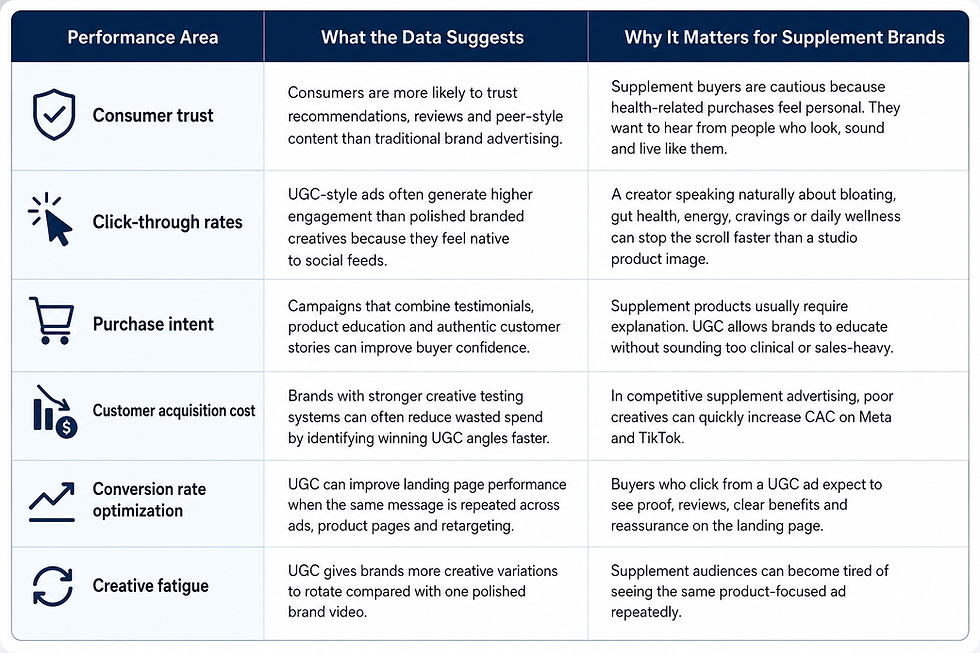
The data makes a compelling case for using UGC ads for supplements as a core part of paid
social growth. In health supplement marketing, buyers often need reassurance before purchasing because they are evaluating trust, ingredients, outcomes, brand credibility and peer experience.
Performance Area | What the Data Suggests | Why It Matters for Supplement Brands | Marketing Takeaway |
Consumer trust | Consumers are more likely to trust recommendations, reviews and peer-style content than traditional brand advertising. | Supplement buyers are cautious because health-related purchases feel personal. They want to hear from people who look, sound and live like them. | Use peer-style content in ads to build trust before pushing product features. |
Click-through rates | UGC-style ads often generate higher engagement than polished branded creatives because they feel native to social feeds. | A creator speaking naturally about bloating, gut health, energy, cravings or daily wellness can stop the scroll faster than a studio product image. | Prioritise short UGC hooks in the first 3 seconds of the ad. |
Purchase intent | Campaigns that combine testimonials, product education and authentic customer stories can improve buyer confidence. | Supplement products usually require explanation. UGC allows brands to educate without sounding too clinical or sales-heavy. | Blend customer-style storytelling with simple product benefit explanations. |
Customer acquisition cost | Brands with stronger creative testing systems can often reduce wasted spend by identifying winning UGC angles faster. | In competitive supplement advertising, poor creatives can quickly increase CAC on Meta and TikTok. | Test multiple UGC variations before scaling budget. |
Conversion rate optimization | UGC can improve landing page performance when the same message is repeated across ads, product pages and retargeting. | Buyers who click from a UGC ad expect to see proof, reviews, clear benefits and reassurance on the landing page. | Use winning UGC insights to improve product pages, testimonials and FAQs. |
Creative fatigue | UGC gives brands more creative variations to rotate compared with one polished brand video. | Supplement audiences can become tired of seeing the same product-focused ad repeatedly. | Maintain a rotating library of fresh UGC ads for each product. |
Why UGC Ads Work So Well for Supplements
1. They Reduce Purchase Anxiety
Supplements require trust. User generated content helps reduce this anxiety because the message comes through a relatable voice. Instead of a brand telling people what to believe, the creative shows how someone else discovered, considered or used the product. This is especially useful for new supplement brands that do not yet have strong brand awareness.
2. They Feel Native to Social Platforms
The best UGC ads do not interrupt the feed; they blend into it. They resemble the content people already watch- creator recommendations, morning routines, “things I wish I knew earlier” videos, unboxings, day-in-the-life clips and honest product explainers.
On Meta platforms, this native feel can improve engagement because the creative does not immediately trigger ad resistance.
3. They Make Health Benefits Easier to Understand
Healthcare supplement brands often struggle to explain ingredients, mechanisms and product benefits without sounding overly technical. UGC solves this by translating product value into everyday language. For example, instead of saying:
“Our probiotic supports microbiome balance through targeted strains.”
A UGC-style script may say:
“I started paying more attention to my gut health because I kept feeling heavy after meals. I wanted something simple I could add to my daily routine.”
4. They Support Better Creative Testing
UGC is not one creative format. It is a testing engine. A supplement brand can test multiple angles:
Problem-aware hooks
Ingredient education
Morning routine content
Founder-led explanation
Customer-style testimonial
Unboxing videos
Before-routine versus after-routine storytelling
Myth-busting content
FAQ-style creator videos
Comparison against common lifestyle struggles
This variety gives brands more data to work with. Instead of relying on one expensive branded video, the brand can test multiple creator-led concepts and quickly identify what the audience responds to.
5. They Improve Conversion Rate Optimization
UGC does not only help ad performance. It also supports conversion rate optimization across the full funnel. The same high-performing UGC themes can be repurposed into:
Landing page testimonial sections
Product page videos
Email flows
Retargeting ads
Social proof carousels
FAQ content
Short-form educational reels
Creator-led comparison creatives
When the same message appears across the ad, landing page and retargeting journey, the buyer receives a consistent trust signal. This can improve conversion rates and reduce drop-off between click and purchase.
Who This Guide Is For
This guide is especially relevant for:
Brand Type | Why UGC Ads Matter |
Probiotic brands | Buyers want trust, reviews and simple explanations before trying a new gut health product. |
Women’s wellness brands | Peer-style content helps communicate sensitive concerns in a relatable and respectful way. |
Skin and allergy support supplement brands | UGC can explain daily wellness routines without relying on exaggerated health claims. |
Weight management and metabolic health brands | Creator-led storytelling can support education while avoiding aggressive before-and-after messaging. |
DTC supplement brands scaling Meta ads | Fresh UGC creatives help reduce ad fatigue and improve campaign learning. |
Katalysts supports Healthcare Supplement brands by building UGC-led ad strategies that combine audience research, creative testing, Meta campaign structure and conversion-focused landing page recommendations.
The Right Meta Ad Strategy for Supplement Brands
A successful Meta ad strategy for supplements requires more than boosting posts or running a few reels. The brands that scale usually have a structured creative and media system. At Katalysts, we typically recommend building paid social campaigns around three creative layers.
Layer 1: Problem-Aware UGC
These ads speak to the customer’s daily frustration. For example:
“Feeling bloated after meals?”
“Struggling with sugar cravings in the afternoon?”
“Trying to support your skin from the inside out?”
“Looking for a simple gut health routine?”
The goal is to make the viewer feel understood without making exaggerated or non-compliant medical claims.
Layer 2: Product Education UGC
These creatives explain what the supplement is, who it is for and how it fits into a routine. This is where ingredient education, usage guidance and product differentiation become important.
For supplement brands, this layer is critical because consumers want to know why your product is different.
Layer 3: Social Proof and Retargeting UGC
These ads help move warm audiences toward purchase. They may include customer reviews, creator feedback, product routine videos, comparison-style messaging or trust-building proof points such as formulation quality, testing standards, retail availability or brand credibility. This layer is often where conversion rate optimization (CRO) becomes most visible, because the audience already has some awareness and needs reassurance before buying.
Actionable Strategies for Building a High-Converting UGC Ad Library
Building a sustainable UGC pipeline requires deliberate systems, not luck. Healthcare supplement brands need a structured process for sourcing creators, briefing content, testing angles, securing usage rights and refreshing ads regularly. The goal is not just to collect videos. The goal is to build a performance-ready creative library that supports paid social ads, retargeting and conversion rate optimization.
UGC Ad Library Step | What to Do | Why It Works for Supplements | Example Execution |
Identify vocal customers | Use post-purchase emails, reviews, loyalty programs and social listening to find customers who already engage with the brand. | Real customers often communicate benefits in a more relatable way than the brand can. | Ask satisfied customers to share a short routine-based video about how they use the supplement. |
Choose the right creators | Select creators who match your buyer profile, not just creators with large followings. | A gut health supplement for women over 40 should not rely only on young fitness influencers. Relevance matters. | Use creators who reflect the target audience’s age, lifestyle, health goals and daily environment. |
Create structured briefs | Give creators a flexible script framework: problem, routine, product experience and reason to consider. | Supplements need explanation, but overly scripted content feels fake. A guided brief keeps the message clear while preserving authenticity. | Brief format: “What problem were you trying to solve? How did you use the product? What made it easy to add to your routine?” |
Test different hooks | Build multiple opening lines for the same product. | The first few seconds decide whether users continue watching. Different pain points will appeal to different buyers. | Test hooks like “I didn’t realise my gut health was affecting my energy” or “Three things I check before buying a probiotic.” |
Capture multiple formats | Ask each creator for testimonial videos, routine videos, unboxings, FAQ clips and product explanation videos. | One creator shoot can produce several ad variations for Meta, TikTok, Reels and retargeting. | Turn one creator video into 5 ad assets: short hook, routine version, review version, objection-handling version and retargeting version. |
Secure usage rights | Get written permission to use creator content in paid ads across defined platforms and time periods. | UGC used in supplement advertising must be legally safe for paid media usage. | Add usage rights terms before launching the creator video as a Meta ad. |
Keep claims compliant | Avoid disease-treatment claims, unrealistic promises or misleading before-and-after messaging. | Supplement ads can face platform restrictions and consumer trust issues if claims are too aggressive. | Replace “cures bloating” with “supports my daily gut health routine.” |
Build a creative testing calendar | Plan monthly UGC refreshes with new creators, hooks, formats and angles. | Supplement ads fatigue quickly. Fresh creative keeps campaigns learning and prevents performance decline. | Test 10–15 new UGC variations monthly across prospecting and retargeting campaigns. |
Connect UGC to landing pages | Use the same messaging from winning ads on product pages, FAQs and review sections. | Conversion improves when the post-click experience matches the ad promise. | If an ad about “daily gut health routine” performs well, add that same routine angle to the landing page. |
Analyse and scale winners | Track hook rate, thumb-stop rate, CTR, CPC, add-to-cart rate, CPA and ROAS. | UGC success should be measured by performance, not just engagement. | Scale ads that combine strong watch time, high CTR and efficient purchase cost. |
For supplement brands that want to scale profitably, Katalysts can help build the full system: creator briefs, Meta campaign structure, UGC testing, landing page review, retargeting and performance reporting.
FAQs about UGC Ads for Supplements
1. What are UGC ads for supplements?
UGC ads for supplements are paid social ads that use creator-style or customer-style content to promote health and wellness products. These ads often look like native social media videos rather than polished brand commercials. They may include product routines, testimonials, unboxings, review-style clips, ingredient explainers or everyday lifestyle content showing how a supplement fits into a customer’s routine.
2. Why do UGC ads perform better than branded supplement ads?
UGC ads often perform better than branded supplement ads because they feel more authentic, relatable and native to platforms like Instagram, Facebook, TikTok and Reels. In supplement advertising, buyers are often cautious about health claims, ingredients and expected results. Peer-style content helps reduce skepticism by showing the product through a human experience.
3. How can supplement brands use UGC ads on Meta?
Supplement brands can use UGC ads on Meta by building campaigns around different stages of the buyer journey. For prospecting, brands can test problem-aware UGC hooks such as gut discomfort, wellness routines, sugar cravings, bloating or low energy. For retargeting, brands can use testimonial-style videos, product explainers, customer review creatives and objection-handling ads.
4. What types of UGC content work best for health supplement marketing?
The best UGC content for healthcare marketing usually includes relatable stories, clear product routines and trust-building explanations. Common high-performing formats include:
Morning routine videos
“Why I started using this” videos
Product unboxings
Customer-style reviews
Ingredient explanation videos
FAQ-style creator videos
Problem-solution storytelling
Comparison between old and new routines
Retargeting videos addressing buyer objections
5. How many UGC ads should a supplement brand test each month?
A supplement brand should ideally test fresh UGC ads every month because creative fatigue can happen quickly on paid social platforms. For active campaigns, testing 10 to 15 new UGC variations per month is a practical starting point. Larger DTC supplement brands may need more variations depending on ad spend, product range and audience size.
6. What makes a high-converting UGC ad for supplements?
The content should feel natural but still be strategically structured. A strong UGC ad often follows this flow:
Identify a real customer concern
Show why the creator started looking for a solution
Introduce the supplement naturally
Explain how it fits into a daily routine
Add a trust signal or product benefit
Invite the viewer to learn more or shop
For supplement brands, the message should also stay compliant and avoid exaggerated health claims.
7. Are UGC ads safe for supplement advertising compliance?
UGC ads can be safe for supplement advertising when they are reviewed carefully before being used in paid campaigns. Supplement brands should avoid disease-treatment claims, unrealistic promises, misleading testimonials, exaggerated before-and-after messaging and claims that cannot be substantiated.
8. How can Katalysts help supplement brands with UGC ads?
At Katalysts, we help supplement brands build and scale UGC-led paid social campaigns. This includes UGC ad strategy, Meta campaign planning, creator brief development, ad copy, creative testing, landing page review, retargeting strategy and performance analysis.
9. Why should DTC supplement brands work with a digital marketing agency for UGC ads?
DTC supplement brands should work with a digital marketing agency for UGC ads because successful paid social requires more than creator videos. It requires strategy, testing, compliance awareness, funnel alignment and performance optimization.
10. What is the first step to launching UGC ads for supplements?
The first step is to audit the current customer journey. A supplement brand should review its existing ads, product pages, customer reviews, audience segments, key objections and best-selling products. From there, the brand can identify the strongest UGC angles to test.
The Future of Health Supplements Advertising
The future of supplement advertising is not about choosing between branded creatives and UGC. It is about knowing where each format works best. Branded creatives help with product identity, trust signals and premium positioning. But UGC ads often win the attention and credibility battle on paid social because they feel closer to how real consumers make health decisions.
If your supplement brand is ready to improve ad performance, test better creatives and build a paid social system that converts, we can help you plan, launch and scale your next UGC-led campaign.
Talk to us about building high-performing UGC ads for your supplement brand.


Comments