
AI SEO vs. AEO for Financial Services How to Get Cited by ChatGPT and Perplexity


(A practical guide for financial-services marketers in Singapore and Southeast Asia)
Key Takeaways
AI SEO and AEO don't replace traditional SEO. They build on it.
Citation visibility depends on more than keywords. Relevance, evidence, expertise, accessibility, freshness and authority all play a role.
There's no guaranteed formula. Neither ChatGPT nor Perplexity publishes a complete citation algorithm.
Singapore and Southeast Asia need regional context. Regulations, terminology, and customer behaviour shift from market to market.
The goal isn't more content. It's content worth retrieving, trusting and citing.
A customer in Singapore opens ChatGPT and types a question: Which fintech platforms are best for managing cross-border payments in Southeast Asia? Your company offers exactly that service. You have a strong website. Years of industry experience. Dozens of blog posts. A solid Google presence. Your brand still doesn't show up in the answer. However, a competitor does.
That's the uncomfortable truth about AI search: ranking on Google no longer guarantees a mention in an AI-generated answer. And for financial services, this isn't a future problem. It's already here. McKinsey's 2026 research found that 23% of consumers surveyed use generative AI for financial tasks at least monthly. They're using it to understand products, compare options and get investment guidance. McKinsey also found that large language models were more likely than traditional web search to surface digital lenders, fintechs and credit unions for certain queries.
For banks, fintechs, insurers, payments companies, and wealth managers, that changes the game. The old question was "how do we rank?". The new question is "how do we become a source AI systems trust enough to cite?” That's what AI SEO and Answer Engine Optimization (AEO) are for.
AI SEO vs. AEO: What's the difference, and why the labels keep multiplying
The terminologies can feel overcomplicated - AI SEO. AEO. GEO. LLM SEO. Generative search optimization. The industry hasn't agreed on one definition. What matters is the shift underneath the labels.
AI SEO is the broad view. It's about making your website, content and online presence easy for AI systems to discover, understand and represent accurately. AEO is narrower. It focuses on directly answering the questions people actually ask. In practice, these work together. Technical SEO still affects discoverability. Content quality still matters. Authority still matters. What's changed is where the customer meets your information.
OpenAI says any public website can appear in ChatGPT search. It specifically recommends allowing OAI-SearchBot to access site content, so it can be discovered, surfaced, cited and linked.
AI search isn't killing SEO. It's expanding search from rankings to answers.
Why financial services needs a different playbook, not just a different keyword list
Financial information carries a heavier burden of accuracy than most content categories. A stale restaurant recommendation is a minor inconvenience. An outdated explanation of a regulation, an unsupported investment claim or a wrong statement about a lending product can cost someone real money.
This is exactly where financial content can win. Get the fundamentals right - credible sourcing, transparent authorship, expert interpretation, current information; and you build an advantage competitors can't fake.
Perplexity's own source-review process is a useful signal here. It considers whether a site names its authors, corrects mistakes and separates editorial content from advertising. Some domains get labelled Government, Academic or Trusted. Perplexity is careful to note a label isn't an endorsement of every individual article.
This matters even more in Singapore and Southeast Asia, where brands operate across multiple regulators, rules, and customer expectations. An article about digital lending in Singapore can't just get a find-and-replace for "Indonesia." The authoritative sources change. The regulatory environment changes. The questions customers ask change too.
5 ways financial brands can improve their odds of being cited
There's no secret checklist that guarantees a citation from ChatGPT or Perplexity. If someone promises you one, be skeptical.
AI systems pull from different sources and use different retrieval logic depending on the query. Even OpenAI tells users to double-check cited sources, since results can be incomplete, outdated or wrong. But here are the five clear principles that hold.
1. Start with the real questions, not the keyword list
Financial marketers have spent years building content around keyword lists. AI search makes the intent behind those keywords more important than ever. Take a fintech targeting Singapore SMEs. "Payment gateway Singapore" might be a valuable search term. But the real decision-making questions look different:
How do payment gateways work? What fees should an SME compare? Which payment methods should a business support? How hard is integration? What matters for cross-border payments?
Those questions open up a much richer content opportunity than five variations on one keyword. The same logic applies regionally. A business exploring cross-border payments in Southeast Asia has different questions than a consumer comparing digital banks in Singapore. A CFO evaluating an enterprise payment platform asks something different again.
The goal isn't predicting every AI query. It's understanding what customers actually need to decide. That's a good content strategy with or without AI search.
2. Make every claim verifiable, especially the numbers
This is where financial content should hold itself to a higher bar than most industries. Publishing a market statistic? Show the source. Discussing a regulatory change? Point to the regulator or the official publication. Making a claim about consumer behaviour? Name the research behind it.
For Singapore-focused content, that might mean citing the Monetary Authority of Singapore, government data, recognised research institutions, or company filings. For regional content, the right authority shifts by market.
This isn't just about SEO. Source attribution lets readers check the claim themselves. It also gives AI systems a stronger foundation to retrieve and synthesise from. OpenAI's own guidance reinforces this: cited sources should be checked against the original material, especially when accuracy matters.
Financial brands should go one step further. Don't just link to a source. Explain what it actually says. That's the line between aggregation and expertise.
3. Make complex financial information easy to use, not just accurate
A page can be technically correct and still hard to use. This happens constantly in financial content. The article opens with three paragraphs about digital transformation. The actual definition shows up halfway down. The key statistic hides in paragraph eight. The important regulatory change is buried inside a 60-word sentence. Nothing here is wrong. It's just too much work for the reader.
Clear structure fixes this. Use descriptive headings. Define unfamiliar terms as you go. Put answers where readers expect them. Break comparisons into short, logical sections. Use tables when they genuinely help someone decide.
Most importantly, say the important thing first. If you're explaining embedded finance, don't make readers dig the definition out of a paragraph about the future of banking. Tell them
what it means. Then add nuance.
This isn't about writing for AI. It's about respecting the reader's time. And content built clearly for people tends to be easier for machines to interpret too.
4. Show interpretation, not just information
This is where most financial content programmes hit a ceiling. The internet already has an enormous amount of content explaining what fintech, digital banking, open banking and lending mean. AI systems can already summarise that well. So why would they need another generic explainer? The real opportunity is interpretation.
Take a new regulatory announcement. A basic article summarises what the regulator said. A stronger article explains what actually changed, which businesses are affected, what it means operationally, and what questions teams should be asking next. The second piece has something the first one doesn't: expertise.
This gap matters more as AI gets embedded deeper into financial services itself. McKinsey's 2026 research describes AI as increasingly shaping banking customer relationships, with consumers already using it for everyday financial tasks.
Financial brands have a real opening here, not just to publish information but to become interpreters of their market. Original research, expert commentary, proprietary data and first-hand regulatory analysis all build that layer.
5. Build authority beyond your own website
Your website is only one part of your digital footprint. Financial companies get discussed across news publications, industry sites, research reports, partner content, events and analyst coverage. AI search doesn't stop at your blog, it picks up information about you everywhere else too. For a Singapore fintech, a mention in a credible financial publication, a contribution to an industry report or original research picked up elsewhere all build context around your brand.
This is where SEO, content marketing, thought leadership and digital PR converge. The goal isn't manufacturing mentions. It's building legitimate authority around the topics you want to own. It's a longer game but a far more defensible one than chasing the latest AI-search trick.
What this means for Singapore and Southeast Asia specifically
Regional financial marketing adds another layer of complexity. Regulations differ, market maturity, customer needs and terminology differ. Even the sources an AI system should trust differ by market.
A regional AI-search strategy needs market-specific content intelligence. For Singapore, regulatory and institutional sources carry particular weight. For a Southeast Asian expansion strategy, marketers need to understand how the information landscape shifts market to market.
Localisation isn't merely translation here. Good regional content changes the context, not just the country name.
AI SEO vs. AEO: which one should financial marketers prioritise?
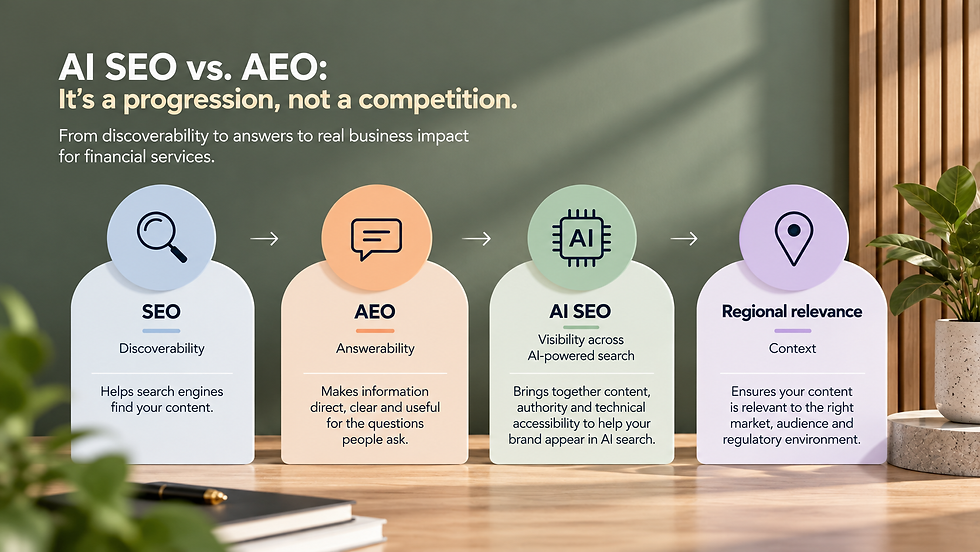
Here’s the short answer. Don't treat them as competitors. Traditional SEO builds discoverability. AEO makes information directly answerable. AI SEO takes the broader view - how content, authority and technical accessibility work together across AI-powered search.
Think of it as a chain:
SEO → Discoverability
AEO → Answerability
AI SEO → Visibility across AI-powered search
For financial-services brands, there's a fourth link:
Regional relevance → Context
Being cited for a broad fintech question is different from being cited for Singapore fintech regulation, Southeast Asian payment infrastructure or digital banking in one specific market. Your strategy needs to account for all of it.
What financial brands should stop doing
AI search doesn't mean throwing out everything you know about content. But a few habits deserve a second look.
Publishing an article just because a keyword has volume rarely pays off anymore.
Rewriting five competitors' articles into a slightly longer version isn't differentiation.
Publishing statistics without sources weakens your credibility.
Leaving regulatory content untouched for years creates an obvious freshness problem.
And churning out generic AI-written content makes your site bigger, not more authoritative.
The better question is: What does our audience need to know, and what can we explain better than anyone else? That question leads to better content, whether the reader arrives through Google, ChatGPT, Perplexity, LinkedIn or a direct recommendation.
How should financial brands measure AI search visibility?
Traditional SEO reporting revolves around rankings, traffic, impressions, and conversions. AI search adds another layer on top.
Financial brands can start tracking:
visibility across a defined set of priority AI queries
brand mentions
cited pages
competitors appearing in the same answers
third-party sources cited alongside competitors
branded versus non-branded AI visibility
AI referral traffic
AI-assisted conversions
Consistency matters most here. One ChatGPT query isn't a measurement programme. AI answers shift based on query wording, platform, timing, geography and available sources.
The better approach is to build a repeatable set of high-value questions and track how the answer landscape changes over time. That turns AI visibility into something your team can actually learn from, not a folder of interesting screenshots.
The Katalysts Approach to AI search
For financial-services brands, AI search sits at the intersection of several disciplines, not inside one team's remit.
Research → Strategy → Content → Authority → AI Visibility → Measurement
Execution looks different for every brand. A Singapore fintech building category awareness needs something different from a bank targeting retail customers across Southeast Asia. An insurer needs a different content architecture than a B2B payments platform.
That's why there's no single universal AI SEO checklist. The starting point is always the same four questions:
What are your customers asking?
Which sources does AI currently rely on?
Where is your brand missing from those conversations?
What can your organisation contribute that's genuinely useful and credible?
Those four questions turn AI search from a content-production task into a visibility and authority strategy.
Frequently Asked Questions (FAQs)
What is AI SEO for financial services?
AI SEO is the broad practice of making a financial brand and its content easy for AI systems to discover, understand and represent accurately. It builds on traditional SEO but accounts for the wider AI-search environment.
What is AEO?
Answer Engine Optimization focuses on directly answering the questions users ask search and answer engines. Strong AEO means clear answers, logical structure, relevant context and information that's easy to verify.
Can financial brands guarantee a ChatGPT citation?
No. There's no public formula that guarantees one. OpenAI says public websites can appear in ChatGPT search and recommends allowing OAI-SearchBot to access content, so it can be discovered and cited. Citation visibility still depends on the query, available sources and the platform's retrieval process.
How does Perplexity evaluate sources?
Perplexity's source-label system looks at factors like authorship, correction practices, and whether editorial content is separated from advertising. Some domains get labelled Government, Academic, or Trusted. A label doesn't guarantee the accuracy of every article from that source.
Does traditional SEO still matter for AI search?
Yes. AI systems still need to discover and retrieve information first. Technical accessibility, crawlability, useful content, and site authority remain the foundation.
Should fintechs focus on AEO or GEO?
Don't get stuck choosing a label. Focus on the underlying goal: becoming discoverable and credible for the questions your audience asks. The strongest strategies combine traditional SEO, AEO, content authority and digital PR.
Does publishing more content improve AI visibility?
Not on its own. More content means more information about your brand exists but volume alone doesn't build authority. Well-sourced, current, expert-led content is a far more meaningful goal for financial services than publishing at scale.
How often should financial content be updated?
There's no universal interval. Review content whenever the underlying facts can change including regulations, rates, market data, product details, statistics, technology. Clear publish and update dates also help readers judge how current the information is.
The bottom line
AI search doesn't mean search engines are disappearing. It means the search result is becoming an answer.
And every answer needs a source.
For banks, fintechs, insurers, payments companies, and wealth managers across Singapore and Southeast Asia, the opportunity is bigger than optimising a few pages for ChatGPT. It's about building a digital footprint that's relevant enough to retrieve, credible enough to trust, and useful enough to cite.
The brands that get this right aren't chasing mentions.
They're building something more valuable: becoming one of the sources people — and AI systems — turn to when the question actually matters.


Comments